· ReadyStack
Worked example
Real numbers from this tool, line by line.
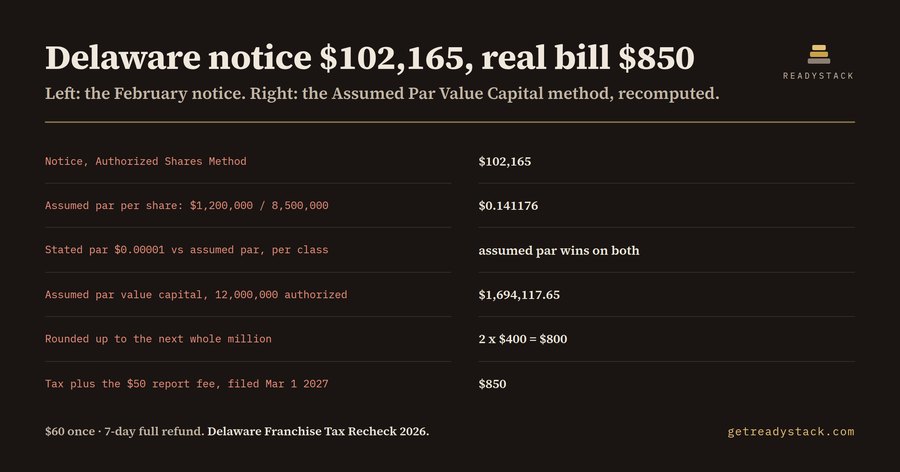
A Delaware C-corp whose February notice reads $102,165 owes $850 — and the founders and bookkeepers who run US startups are the ones holding that notice.
Delaware bills corporate franchise tax two ways, and the notice it mails you is priced the expensive way.
The Authorized Shares Method is the default. It ignores what your company is worth and counts only how many shares you were allowed to issue: $175 for 5,000 shares or fewer, $250 up to 10,000, and $85 for every additional 10,000 shares or portion of them, capped at $200,000. A venture-backed startup with 10,000,000 authorized common and 2,000,000 authorized preferred has 12,000,000 authorized shares. That is 250 + 1,199 x 85 = $102,165.
The Assumed Par Value Capital Method does look at it, and almost every startup pays far less under it. Take the same company: $1,200,000 of total gross assets from Schedule L of Form 1120, and 8,500,000 shares actually issued. Divide gross assets by issued shares and you get an assumed par value of $0.141176 per share. Apply that to the authorized shares of each class — but only where it beats the class's stated par value, because a class whose stated par is higher is valued at its stated par instead. Here the stated par is $0.00001, so the assumed par wins on both classes: $1,411,764.71 on common and $282,352.94 on preferred, for an assumed par value capital of $1,694,117.65. Round that up to the next whole million, which is 2, and multiply by $400. The franchise tax is $800. Add the $50 annual report fee for a non-exempt domestic corporation and the total owed by March 1, 2027 is $850.
On that one cap table the two methods differ by $101,365.
Two steps decide the answer, and they are the two steps that get dropped. The first is the per-class floor: you cannot apply the assumed par value to a class whose stated par is higher. The second is the round-up — the tax is $400 per million or portion of a million, so $1,694,117.65 is billed as two millions, not 1.69. Ask a chatbot and it will apply the assumed par to issued shares instead of authorized, round to the nearest million instead of up, or forget the floor. Delaware's own calculator is accurate, but it asks you to start from a notice you may not have in front of you, and it will not tell you what the gap between the methods is costing you.
Filing late has its own arithmetic. The statutory penalty is $200 flat, plus 1.5 percent interest per month on tax and penalty together. On the same company, filing on June 15, 2027 instead of March 1 is 106 days late: $200 plus four months of interest on $1,000, which is $260 on top, and a total of $1,110 rather than $850.
Delaware Franchise Tax Recheck 2026 is a browser extension that runs both methods on the same inputs and shows the notice figure, the lawful figure, the gap, and what a late date adds. The calculation is free, with no key, no cap and no watermark. A $60 licence key adds the two things that sit on different axes: a .csv export of the full worked sheet to keep or hand to a CPA, and a March 1 alarm that repeats every year. A registered agent files the annual report for you at about $100 per filing, $50 to $200 across providers — per company, per year.
The rates, brackets and the $400-per-million step here come from the Delaware Division of Corporations pages at corp.delaware.gov/frtaxcalc and corp.delaware.gov/paytaxes, read on 2026-09-22. The tool reproduces Delaware's own published example — 1,000,000 shares at $1.00 par, 250,000 shares at $5.00 par, 485,000 issued, $1,000,000 gross assets — at $1,600, digit for digit.
15 seconds — what it actually does
Full walk-through
Questions people ask
What does this actually do?
It takes your Delaware C-corp cap table - authorized common and preferred, each par value, total issued shares and gross assets - and computes the franchise tax twice: once by the Authorized Shares Method that Delaware's February notice uses, and once by the Assumed Par Value Capital Method. It shows both, the lower lawful figure, and the difference.
Who is this for?
Founders, bookkeepers and fractional CFOs of Delaware C-corporations, especially venture-backed startups that authorized ten million or more shares at a par value of $0.00001. Those companies get the largest notices and are the ones most likely to pay a number they never owed. Registered agents and CPAs filing on behalf of clients use it too.
Why not just use a free calculator or a chatbot?
Delaware's own calculator asks for figures off the notice you may not have received yet, and it will not tell you what the gap costs. Chatbots routinely drop the two steps that decide the answer: the per-class floor where stated par beats assumed par, and rounding the assumed par value capital up to the next whole million.
What is free and what needs the key?
Every calculation is free forever: both methods, the lower figure, the notice gap, and the late penalty. Nothing is capped, watermarked or locked after N uses. The $60 key adds two things on different axes - a .csv export of the full worked sheet to keep or hand to a CPA, and a repeating March 1 alarm.
What would it cost to have a person do this?
Registered agents file the Delaware annual report and franchise tax for you as an add-on service, commonly around $100 per filing, with service fees across providers running roughly $50 to $200. That is per company, per year. A one-time $60 key covers the same recheck for as many corporations as you file for.
Ask about this tool
One question, answered by the person who built it. Your email only if you want the answer sent.